


Water is life—and the policies that govern it shape everything from the drinking water in your tap to the health of rivers, lakes, and wetlands. Decisions made in statehouses and Washington impact drought preparedness, flood protection, clean water access, energy production, agriculture, and the global economy. Paying attention to water policy isn’t just civic responsibility—it’s about safeguarding communities, ecosystems, and the future of the planet.
The Federal Water Tap is a weekly digest showcasing U.S. government water policy news.
Sign up to get the Federal Water Tap newsletter delivered directly to your inbox every Monday.
Federal Water Tap, March 23, 2026: U.S. Spy Agencies Again Neglect Water, Climate in Annual Threat Assessment


The Rundown
- National intelligence agencies do not directly mention water and climate in the annual national security threat assessment.
- Maryland representatives question the GSA about a Legionella outbreak in a federal building.
- A cyanobacterial liver toxin is one of nine contaminants the EPA has decided not to regulate in drinking water.
- Interior Department awards $889 million to western U.S. water storage and canal projects.
And lastly, FEMA reinstates a grant program for climate-resilient infrastructure.
“African governments will use their wealth in critical minerals to seek partnerships that deliver them meaningful benefit. Concurrent conflicts and crises across the continent will continue to put U.S. citizens at risk and cause further instability. Infectious diseases endemic to Africa continue to crop up in new regions and threaten to spill over.” – Tulsi Gabbard, director of national intelligence, speaking at a Senate hearing on the latest threat assessment.
By the Numbers
$889 Million: Grant funding awarded for water storage and delivery projects in the western states. The largest awards go to California canals – $235 million for the Delta-Mendota canal and $200 million to restore lost capacity in the Friant-Kern canal due to subsidence. Farmers pumped so much groundwater that the land surface dropped around the Friant-Kern canal and displaced portions of the key irrigation structure. The funding comes from legislation signed into law in 2025.
$130 Million: Grant funding available for large-scale water recycling projects in the western states. The application period is open through May 13.
News Briefs
Unregulated Contaminants Decision
Every few years the EPA requires water utilities to sample and test for several dozen unregulated drinking water contaminants. The law then requires the agency to decide whether to regulate at least five of those contaminants.
The EPA chose nine contaminants this cycle and decided not to regulate them in drinking water.
The agency determined that these nine contaminants do not occur frequently enough to warrant national regulation.
The list includes a cyanobacterial liver toxin (microcystin), an insecticide (permethrin), a metal (molybdenum), and a pesticide (tribufos).
Legionella Outbreak
An outbreak of the bacteria that cause Legionnaires’ disease, a waterborne respiratory illness, at the George H. Fallon Federal Building, in Baltimore, prompted Maryland representatives to seek more information.
Nine members of the Maryland delegation wrote a letter to the General Services Administration, which oversees federal buildings. They want details on the GSA’s Legionella testing, response, and public notification procedures.
In context: America’s Deadliest Waterborne Disease Is Not Letting Up
Studies and Reports
Threat Level
Water and climate used to be common features in the annual report assembled by the nation’s spy agencies on primary global threats to U.S. national security.
That is, until the Trump administration’s second term.
Like last year’s report, the 2026 worldwide threat assessment ignores these environmental risks.
For other environmental matters, the report highlights critical minerals in Africa and the potential spread of infectious diseases like mpox and Ebola.
Water is mentioned indirectly as “critical infrastructure” that is being targeted in cyberattacks. Hackers in Iran, Russia, and China have disrupted water systems in the United States in recent years.
On the Radar
House Hearing
On March 25, a House Appropriations subcommittee will hold an oversight hearing on the National Weather Service.
Spring Weather Outlook
NOAA released its spring weather outlook, which shows dry conditions persisting in the West and minor flood risk along the Mississippi River basin as the climate undergoes a transition period between La Niña and El Niño.

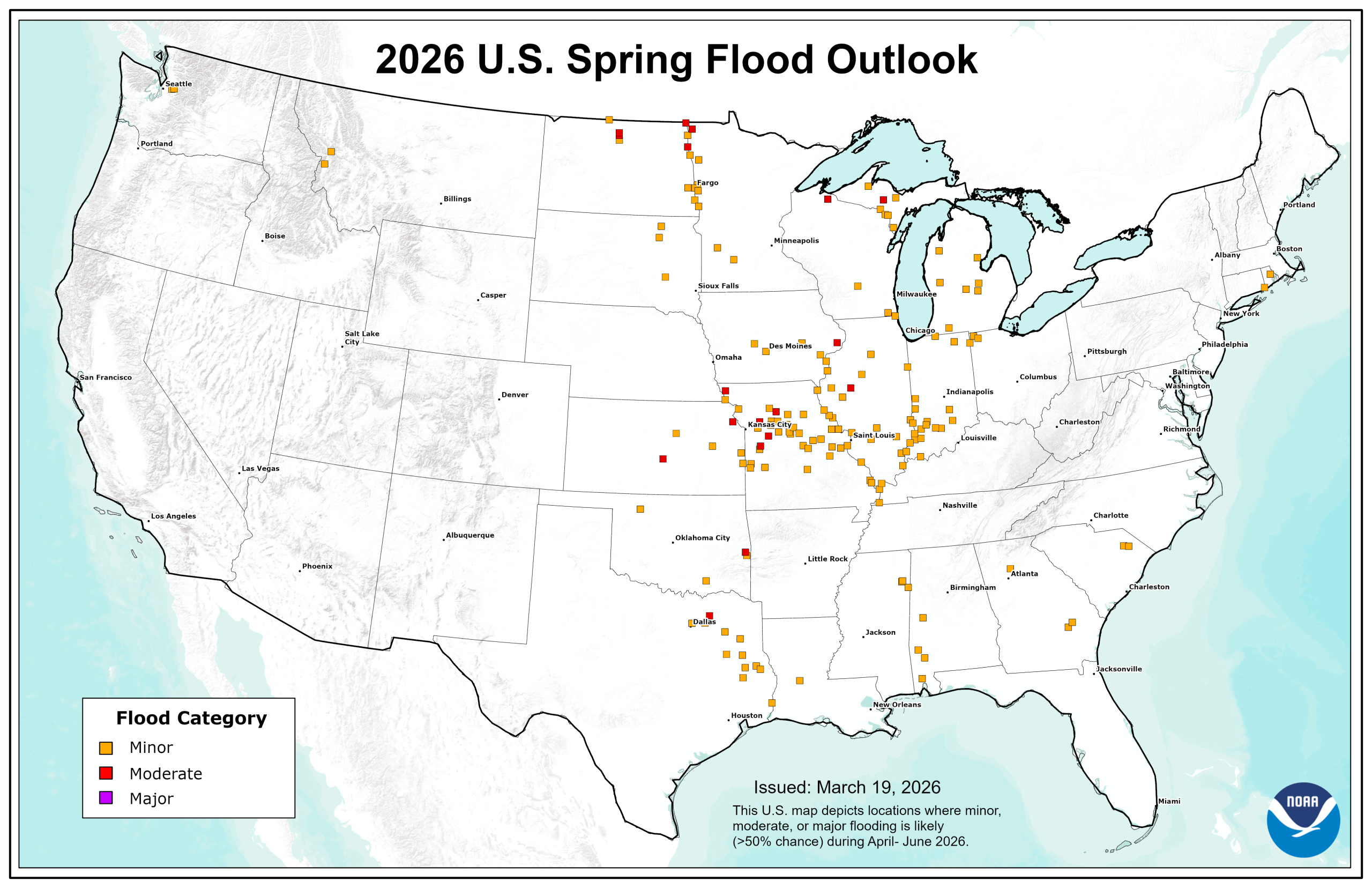
There is moderate flood risk along the Red River of the North, which divides North Dakota and Minnesota.
Winter 2025-26 was the warmest on record for much of the West and what little snow fell in the mountains is melting quickly.
FEMA Reinstates Climate Grants
Due to a court order, FEMA has revived a multibillion-dollar grant program to help communities build infrastructure that will withstand threats from a warming climate, the New York Times reports.
The Building Resilient Infrastructure and Communities program was established in the first Trump administration but briefly cancelled in the second before a district court judge ruled the action was illegal.
Federal Water Tap is a weekly digest spotting trends in U.S. government water policy. To get more water news, follow Circle of Blue on Twitter and sign up for our newsletter.
