
A version of this article was first published by the Salt Lake Tribune on April 28, 2026. It was reported and edited in collaboration with Main Street Media Cooperative, which assigns veteran New York Times correspondents to assist local news organizations in reporting the effect of changes in Washington on their communities.
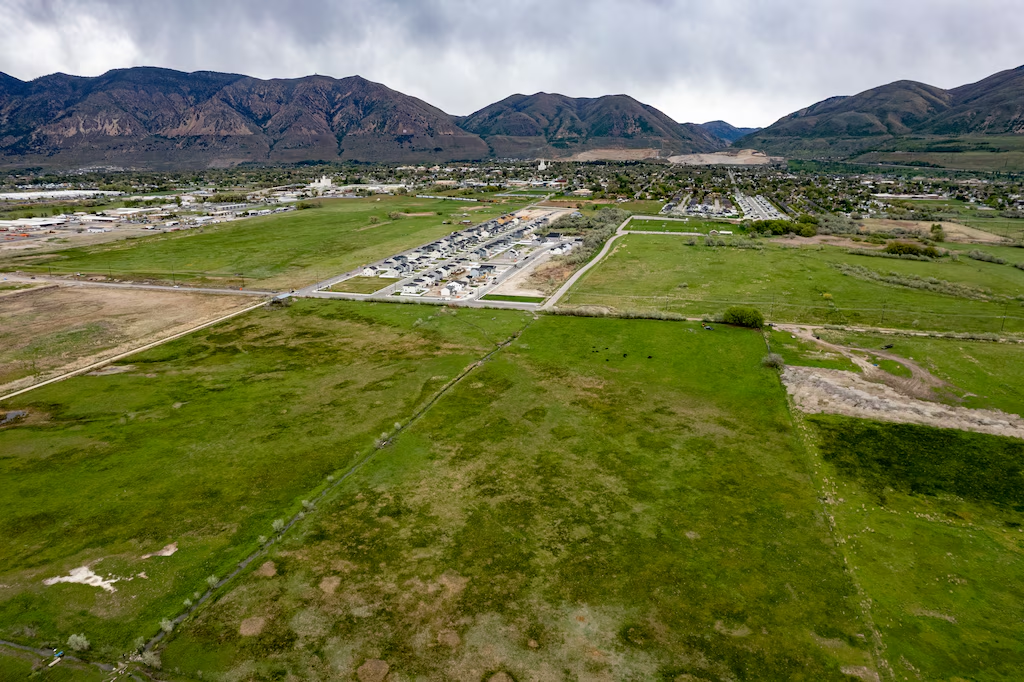
BRIGHAM CITY – The gala premiere for Utah’s audacious plan to build a “full scale nuclear energy ecosystem” occurred last November in this city famous for peaches, not atoms.
Gov. Spencer Cox and Brigham City Mayor D.J. Bott, trading broad smiles and emphatic handshakes, unveiled a momentous plan to remake this city of 20,000 into the West’s epicenter of commercial nuclear energy development.
Their vision, ambitious and expansive, includes a new training center for thousands of nuclear industry workers, and manufacturing plants and machine shops in Brigham City to turn out reactor vessels and other parts for small modular reactors. The small reactors (SMRs), theoretically less expensive and can be transported to construction sites, are one of the go-to electrical generating ideas of the 21st century — though there are no commercial SMRs operating in America. Utah authorities envision fabricating and installing 10 SMRs around the state, along with new transmission infrastructure.
Since then, Gov. Cox pitched an even larger role for commercial nuclear development in Utah — building plants to fabricate fuel and store radioactive waste, plus federal “innovation campus” sites around the state. In effect, the governor is pursuing an estimated $100 billion in new engineering, manufacturing, waste disposal, and transmission capacity, the most ambitious industrial policy since Utah settled the desert and established its nearly $3 billion agriculture industry.
Not discussed that day — or in the events that occurred in the 13 previous months in the governor’s office, the Legislature, and in the executive suites of Holtec International and Hi Tech Solutions, the principal nuclear companies involved — was this question: Can Utah actually pull it off? In other words, is Utah’s vision of an entirely new nuclear sector, in effect turning Brigham City into the Detroit, or Pittsburgh, or Silicon Valley of nuclear development, practical? Improbable? Or just plain impossible?
The answer rests not only in what Gov. Cox and the other project principals insist is possible. More significantly are these three factors, largely not taken into full account by state officials or Utah’s citizens.
Big Challenges
First is that a new industry rising over the next decade along Interstate 15 depends on a fortuitous convergence of trends that include a steady increase in energy demand, and an as-yet unproven lessening of nuclear development and construction costs.
Second are potentially significant environmental risks, especially in water supply and use. Utah is already a water-scarce desert state. It’s two iconic water bodies – the Great Salt Lake and the Colorado River – are steadily receding, reflecting a precipitous climate change-influenced decline in snowfall.
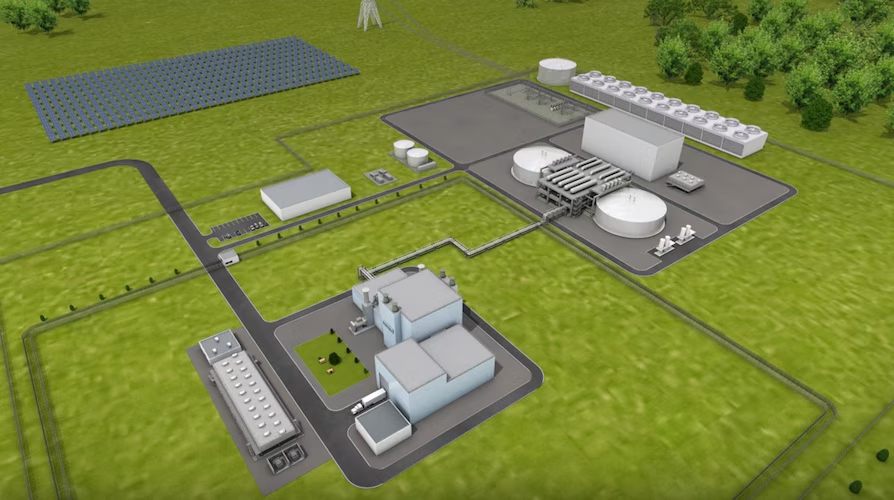
Holtec’s SMRs can be air-cooled, the company says. But if they’re not they each use 12,500 gallons of water a minute, 18 million gallons a day. By industrial standards in the water-bountiful Midwest and South, that’s not a particularly large amount of water. But in Utah it’s significant, especially if 10 water-cooled SMRs are built.
Fresh water use, and waste water disposal also are potential concerns for the uranium mining, nuclear fuel manufacturing and waste disposal elements of Gov. Cox’s plan. Mining and fuel manufacturing produces radioactive tailings that are piled in huge mounds. Since 2007 the U.S. Department of Energy has spent $1 billion clearing and safely disposing a 16 million ton uranium mill tailings pile in Moab.
Radioactive mill tailings can be dangerous. They were the source of one of the worst environmental disasters in U.S. history in 1979 in Church Rock, New Mexico, 270 miles south of Moab. A containment dike breached in United Nuclear Corporation’s uranium mill tailings disposal pond, releasing 1,100 tons of solid radioactive mill waste and about 93 million gallons of acidic tailings into a tributary of the Puerco River, producing years of contamination along the river.
“What is often ignored here is the environmental impact of the entire nuclear fuel chain,” said Lexi Tottenham, executive director of Healthy Environment Alliance of Utah. “Every point in the fuel chain you have the creation of radioactive and toxic products. They all have to be dealt with. And virtually always, it’s going to be in someone’s backyard.”
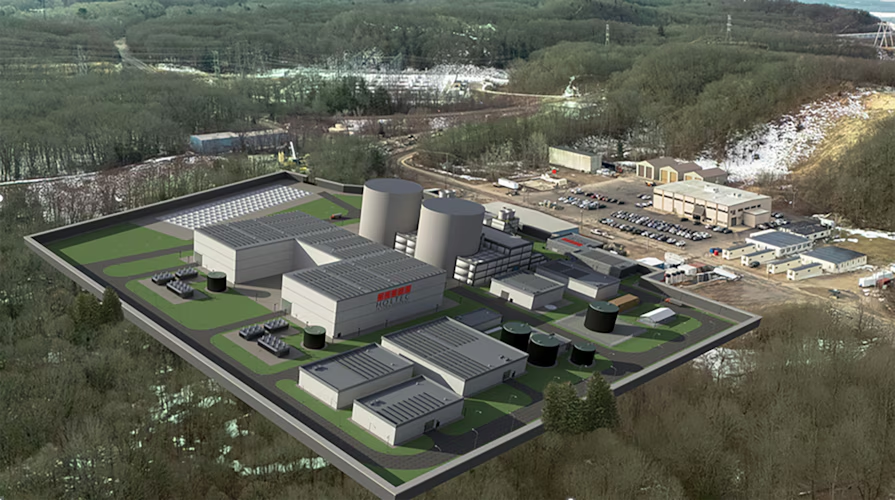
Also this third challenge. Achieving Utah’s full scale nuclear energy ecosystem depends on SMR projects already underway in other states performing with exceptional cost and operational efficiency. Of particular interest is Holtec’s plan to build two 340-megawatt SMR’s in a nuclear generating station in Michigan. The company proposes to build and install those same nuclear reactors in Utah sometime in the mid-2030s. Holtec is not likely to pursue development in Utah if its first SMR project in Michigan falters.
“Once you build one people can come and see and touch and feel. That’s when you see the order book grow,” said Patrick O’Brien, director of Holtec’s government affairs and communications. “Feedback from utilities is, hey, great design. Understand it. But they don’t want to take on a first-of-its-kind risk.”
For that last reason, Utah officials and executives of the two nuclear companies decided to reduce the risks by undertaking in several phases a plan of development they now call “Project Crossroads.”
The first phase, described in a memorandum of understanding made public in May 2025, is to establish Brigham City as a center of workforce training, engineering, and fabrication for the existing commercial nuclear industry, and its nearly 100 operating plants across the country. Hi Tech Solutions is now assembling land to build a $5 million, 20,000 square-foot facility to house its training program for welders, the start of a big nuclear services campus in Brigham City.
The second phase, which the memorandum said would start in 2028, is designing and constructing Holtec’s nuclear manufacturing facility to produce parts for the existing nuclear sector, and for the company’s Utah-based SMRs in the 2030s.
“This will work,” said Chris Hayter, president and co-founder of High Tech Solutions, who is moving the headquarters for the 23-year-old company to Utah from Kennewick, WA. “The worst case scenario is we develop a wonderful manufacturing and workforce development center for the current nuclear industry that’s already delivering 20 percent of the electricity in the United States.”
It’s the third phase, actually manufacturing parts and building new SMRs by the mid-2030s, that nuclear authorities say is a longshot goal. “It’s a nuclear reactor, right? It’s complicated,” Joseph Romm, a physicist and senior research fellow at the University of Pennsylvania Center for Science, Sustainability and the Media, said in an interview. “No one ever gets it right. The United States has a non-stop history of cost overruns. One always has to remember these are imaginary things. These are experimental technologies that nobody in this country, no one in the entire industrialized world has ever successfully built a commercial SMR.”
“A concern we have is the timeline,” added Tuddenham, of Healthy Environment Alliance of Utah. “Nuclear projects take much longer than initially projected. We have climate change now. We have a few short years to make a profound difference to reduce carbon emissions. This isn’t an energy solution that fulfills our need now.”

A Nuclear Center in the West?
Utah might seem an unlikely place for a commercial nuclear center. Until now Utah’s experience with atomic technology, much of it linked to military applications, has mostly been grim. Atmospheric nuclear bomb test blasts in Nevada in the 1950s showered residents of St. George and other towns with fallout that caused extensive birth defects and cancer. Radioactive radon gas from uranium mining for nuclear weapons left hundreds of state miners with terminal lung cancer. Radioactive wastes from uranium mills, including a big waste pile outside Moab, has taken years and over $1 billion to clean up.
And for at least the last two decades Utah also has been a place where commercial nuclear energy projects died. A proposal made public in 2007 to spend $13.4 billion to build two big 1500-megawatt Westinghouse reactors along the Green River collapsed in 2017, when Westinghouse declared bankruptcy due to mammoth cost overruns from building two new reactors in Georgia.
In 2017, the Utah Associated Municipal Power Systems (UAMPS), a consortium of 50 small utilities in seven western states, reached agreement with NuScale, an Oregon-based nuclear developer, to build a 462-megawatt SMR plant at the Idaho National Laboratory. At the time, NuScale was closing in on being awarded the Nuclear Regulatory Commission’s first license for operating an SMR. Initially projected to cost under $4 billion, the price tag for 6 of NuScale’s 77-megawatt reactors soared to over $9 billion. In 2023, UAMPS cancelled the project.
Gov. Cox and his aides, who didn’t respond to interview requests, clearly recognized these impediments when the administration announced its “Operation Gigawatt” plan in October, 2024. Gov. Cox proposed doubling Utah’s electrical generating capacity to 20 gigawatts by 2034. That goal in itself is a mammoth reach. Adding 10 gigawatts to the grid is the same amount of power that it took Utah 70 years to produce for its current electrical supply, according to the Energy Information Administration, a unit of the U.S. Department of Energy.
The Cox administration and the Legislature, aided by executives from Hi Tech Solutions and Holtec International, have set out to solidify the political consensus to pursue nuclear energy with a series of steps on paper. On April 29, 2025 the Legislature approved five new statutes to advance the concept, including authorizing Utah to collaborate in nuclear development with Idaho and Wyoming. The next day Hi Tech Solutions and Holtec reached a non-binding agreement with Utah to pursue building the first facilities.
In June of 2025, the Legislature appropriated $10 million to support the various pieces of Operation Gigawatt, including a $1.8 million communications and marketing program. Gov. Cox opened a new Energy Development Infrastructure Fund, and directed $5 million for its operation this year. The Department of Environmental Quality received $726,000 to staff a new nuclear programs office.
And throughout 2025, project leaders met with professors in the University of Utah’s nuclear program to talk about graduating more students in the field. “We’re gearing up to provide engineers, and not just nuclear engineers,” said Ed Cazalas, assistant professor of nuclear engineering. “Also mechanical, electrical, construction. All types of engineers are needed for a project like this.”
Favorable Trends
All of this activity coincided with trends the state officials viewed as favorable to their enterprise. Federal and state energy agencies forecast that power demands from data centers, electric vehicles, and growing state populations and enterprises will increase demand for electricity 50 percent by mid-century. More than 70 gigawatts (70,000 megawatts) of new nuclear capacity are now under construction around the world, one of the highest levels in 30 years, according to the International Energy Agency.
More than 30 companies are now involved in developing advanced SMR reactors, according to the Nuclear Regulatory Commission (NRC). SMR projects are in various advanced stages of development and construction in Michigan, Idaho, Tennessee, Wyoming, Texas, and Ontario.
SMRs have helped shift public opinion about nuclear energy because they don’t pour any carbon emissions into the atmosphere and can be air-cooled, reducing demand for water. And because they are viewed as safer than the first generation of big reactors, and can be assembled from manufactured parts, the Biden and Trump administrations decided to pour more than $20 billion into SMR development loans and grants, and billions more in tax credits.
That’s the opportunity that Hayter, of High Tech Solutions, envisioned early in 2024 when he met with the governor and his aides to promote nuclear development as a big feature of Operation Gigawatt. He then recruited Holtec, one of the leaders in the industry, to join the Utah project. The U.S. Department of Energy thought so highly of Holtec’s expertise that it awarded the company $400 million last year to construct its SMR station in Michigan.
“I’ve lived in Utah for going on 17 years,” said Hayter. ”I saw something over time that was developing. They had the willpower to want to be a part of the bigger discussion, and the fortitude, the guts to want to lead.”

Big Pool of Funds
There’s also a lot of money circulating for nuclear development. President Trump’s goal is to quadruple electrical generating capacity from nuclear power from 97 gigawatts today, powered by 94 operating reactors, to 400 gigawatts by 2050. In pursuit of the goal, Westinghouse late last year signed an agreement with the federal government to build ten 1,000-megawatt reactors in the U.S. That agreement is tied to the pact that Trump reached with Japan last October to finance $332 billion “to support critical energy infrastructure in the United States.”
There’s also a pile of private funding available. Amazon, Google, Microsoft, and Meta are among the supersized technology companies building data centers and working out agreements with nuclear companies. In March, the NRC issued a permit to build TerraPower’s 345-megawatt SMR in Wyoming. The reactor, funded by Microsoft founder Bill Gates and the US Department of Energy, has a current price tag of $4 billion and a 2030 completion date. TerraPower is racing Ontario Power, which is building four advanced small reactors along the Lake Ontario shoreline, to be the first to open an SMR plant in North America.
If either project meets cost, completion, and performance goals it could open a $700 billion market for the technology, according to Rui Zhong, a senior consultant in energy and infrastructure at Teneo, a New York-based consultancy.
“All this excitement boils down to what SMRs could potentially become compared to large nuclear reactors,” said Zhong. “It’s easier to build them. They’re designed to be portable with a much shorter construction time frame.”
The big unknown is how much of this fervor is grounded in reality, and how much is hype and marketing. During the last attempt to revive nuclear energy in the U.S., from 2007 to 2010, the NRC counted over 20 nuclear plant proposals to review. But the heat of atomic hope quickly cooled as fracking started to produce ample supplies of natural gas, and much less expensive wind and solar power was gaining momentum. Just two new reactors that started construction during that period actually got built and began operating at Georgia Power’s Plant Vogtle. It took the utility 15 years to finish the project in 2024 at a cost of more than $30 billion.
“Some vendors are overselling the vision,” said Brendan Kochunas, associate professor of nuclear engineering at the University of Michigan. “For it to succeed, one of these companies is going to need to establish a pretty substantial order book.”
Difficult Horizon
Indeed, the path to Utah’s nuclear project is strewn with impediments. The technology is dogged by unconfirmed projections about the safety of SMRs, and old concerns about waste management. Though developers assert they can keep costs in line, a study of SMR development by the Department of Energy in 2023 found that construction costs for the first plants will be high because of limits on the supply chain providing parts, construction experience, and unknown interest rates for financing.
Only three SMRs are operating around the world, two on a small floating barge in Russia and a third in China. “These are experimental technologies,” said Romm, of the University of Pennsylvania. “Both the Russian and Chinese reactors had huge cost overruns.”
State elected leaders are galvanized by Project Crossroads. In February Valar Atomics, a West Coast developer, partnered with the Department of Defense to airlift a 30-ton, 5-megawatt modular reactor from California to Hill Air Force Base. Energy Secretary Chris Wright joined Valar founder Isaiah Taylor on the flight, which was marketed as the first to demonstrate rapid deployment of a nuclear reactor. The reactor is scheduled to be switched on by July 4 at the Utah San Rafael Energy Lab in Emery County, where it will be used for testing and training.
Also this year a resolution urging the federal government not to resume nuclear testing in Nevada was rejected by the Legislature. Lawmakers feared it would be seen as an anti-nuclear statement.
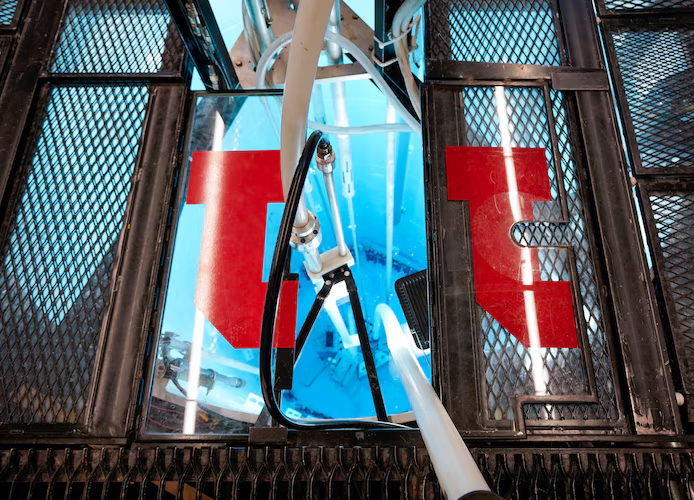
Ted Goodell, the nuclear reactor facility director at the University of Utah offers this clear-eyed assessment: “Companies want to be the first ones with their foot in the Intermountain West,” he said. “They are ready to support a burgeoning nuclear industry out here. But if this AI bubble pops and a bunch of these big tech companies start to walk back from their massive data center ambitions, I think that could really be a nail in the coffin for a new nuclear industry in Utah.
“If the projected electricity demands really pan out, though,” he added, “and we really do need several gigawatts more of extra base load capacity then it could be a really big deal for the state and the region in general. But are you familiar with the other nuclear projects that have been attempted in our region?”
